In a recent study, a team of scientists in China examined the time of day when paper downloads occur from a scientific publisher’s website. Controlling for the time zone where the request originated, they were able to see how hard scientists work overall by examining the downloads for a period of a little over a week. But even more than that, they explored the patterns in their work habits, as well differences between scientists in different countries.
The upshot is that scientists work late at night and on weekends. We have a clear difficulty distinguishing different parts of our lives. But it’s more interesting than that. Chinese and American scientists have somewhat different patterns of workaholism. American scientists work late at night, but still recognize that weekend as a time of rest (at least a little). Chinese scientists, on the other hand, don’t work late at night, but work almost as hard on the weekends as on the weekdays. And Germany is somewhere in between:
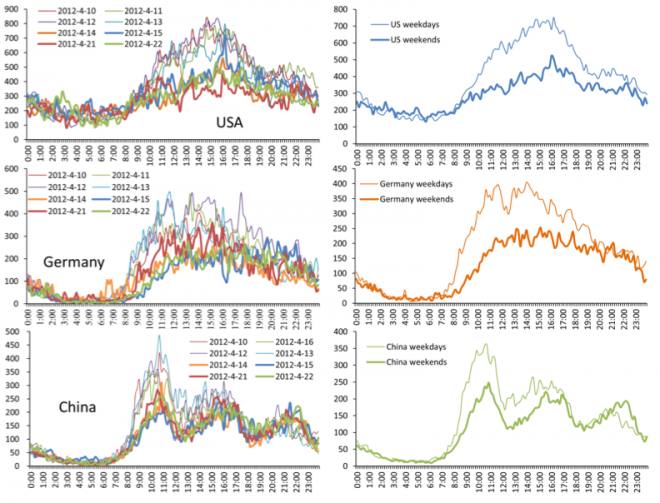
Not wholly compelling, but cute. I am slightly less impressed with our workload when I notice that downloads do not begin until 11am in the US…
Source. Hat tip to Suresh Naidu.

51 Responses
How I Got My Loan Today!!! Hello everyone, I am Janet Williams by name, am writing this Testimony because am really grateful for what CREDIT CENTER FINANCIAL SERVICES did for me and my family, when I thought there was no hope he came and make my family feel alive again by lending us loan at a very low interest rate of 3%. Well I have been searching for a loan to settle my debts for the past three months all I met was scammed and took my money until I finally met a God sent Lender. I never thought that there are still genuine loan lenders on the internet but to my greatest surprise i got my loan without wasting much time so if you are out there looking for a loan of any amount i would advise you to email the legit loan company via email: {creditcenter.co.za@gmail.com} and be free of internet scams. thanks…
Chinese academics might not care for weekends but they seem to be very strict about lunch and dinner time.
How hard do US, Chinese and German academics work?
RT @tylercowen: “I am slightly less impressed with our workload when I notice that downloads do not begin until 11am in the US…” http:// …
How hard do US, Chinese and German academics work? http://t.co/XwDcW1KR
RT @cblatts: How hard do US, Chinese and German academics work? http://t.co/XI1OXZ4U
RT @KnutBerdal: Nice graphics of how hard and when US, Chinese and German academics work. Measured by data download http://t.co/7kV6G77A
“different patterns of workaholism” – comparison between american, german and chinese scientists http://t.co/EP0sGVWd
RT @cblatts: How hard do US, Chinese and German academics work? http://t.co/XI1OXZ4U
How hard do US, Chinese and German academics work? | Chris Blattman http://t.co/5WiZg7wP
RT @cblatts: How hard do US, Chinese and German academics work? http://t.co/XI1OXZ4U
RT @cblatts: How hard do US, Chinese and German academics work? http://t.co/XI1OXZ4U
How hard do US, Chinese and German academics work? http://t.co/chzsLnsV
Nice graphics of how hard and when US, Chinese and German academics work. Measured by data download http://t.co/7kV6G77A
academics use paper download stats to research how hard academics work in China, Germany and US http://t.co/jzujE6pH #whatworklifebalance?
Yes, the U.S. peak is later in the day than Germany or China, but compare 2:00-7:00am. I guess this demonstrates what a lot of us probably already knew: U.S. scholars don’t necessarily work on the 9-5 (or 9-7, or 9-10).
RT @cblatts: How hard do US, Chinese and German academics work? http://t.co/XI1OXZ4U
RT @cblatts: How hard do US, Chinese and German academics work? http://t.co/XI1OXZ4U
Agreed, the results aren’t “compelling, but cute:” RT @cblatts: How hard do US, Chinese and German academics work? http://t.co/Kw7nWsIF
Slackers…How hard do US, Chinese and German academics work? http://t.co/v0tCpKIx @aiddata
RT @cblatts: How hard do US, Chinese and German academics work? http://t.co/XI1OXZ4U
Are you sure that’s not EST in the graph? Average time when downloads start of 11 EST means we’re basically all getting started at 930.
RT @cblatts: How hard do US, Chinese and German academics work? http://t.co/XI1OXZ4U
RT @cblatts: How hard do US, Chinese and German academics work? http://t.co/XI1OXZ4U
RT @cblatts: How hard do US, Chinese and German academics work? http://t.co/XI1OXZ4U
How hard do US, Chinese and German academics work? http://t.co/5iHRxniJ
https://chrisblattman.com/2012/08/31/how-hard-do-us-chinese-and-german-academics-work/
The 11am thing does not surprise me. “@cblatts: How hard do US, Chinese and German academics work? http://t.co/0uOueYVp”
RT @cblatts: How hard do US, Chinese and German academics work? http://t.co/XI1OXZ4U
How hard do US, Chinese and German academics work? http://t.co/vrtoGsb5 via @cblatts
RT @cblatts: How hard do US, Chinese and German academics work? http://t.co/XI1OXZ4U
RT @cblatts: How hard do US, Chinese and German academics work? http://t.co/XI1OXZ4U
RT @cblatts: How hard do US, Chinese and German academics work? http://t.co/XI1OXZ4U
How hard do US, Chinese and German academics work? http://t.co/3Q0YuZmx
@cblatts What is the y-axis? Just straight download #s? If so, just in-country not inter-country comparisons make sense, right?
RT @cblatts: How hard do US, Chinese and German academics work? http://t.co/XI1OXZ4U
RT @cblatts: How hard do US, Chinese and German academics work? http://t.co/XI1OXZ4U
RT @tylercowen: “I am slightly less impressed with our workload when I notice that downloads do not begin until 11am in the US…” http:// …
RT @tylercowen: “I am slightly less impressed with our workload when I notice that downloads do not begin until 11am in the US…” http:// …
“I am slightly less impressed with our workload when I notice that downloads do not begin until 11am in the US…” http://t.co/ZsBHxHim
RT @cblatts: How hard do US, Chinese and German academics work? http://t.co/XI1OXZ4U
RT @cblatts: How hard do US, Chinese and German academics work? http://t.co/XI1OXZ4U
RT @cblatts: How hard do US, Chinese and German academics work? http://t.co/XI1OXZ4U
How hard do US, Chinese and German academics work? http://t.co/x4uutLf6
It’s a fact those self motivated people when engrossed in certain topics or task, days of week, timezone nothing matters. When link is on time is not important till the brain retires and say stop.
In short, most academics are procrastinating until 11am RT @cblatts: How hard do US, Chinese and German academics work? http://t.co/uDSZj8zX
RT @cblatts: How hard do US, Chinese and German academics work? http://t.co/XI1OXZ4U
@cblatts Thanks for highlighting my post!
RT @cblatts: How hard do US, Chinese and German academics work? http://t.co/XI1OXZ4U
RT @cblatts: How hard do US, Chinese and German academics work? http://t.co/XI1OXZ4U
RT @cblatts: How hard do US, Chinese and German academics work? http://t.co/XI1OXZ4U