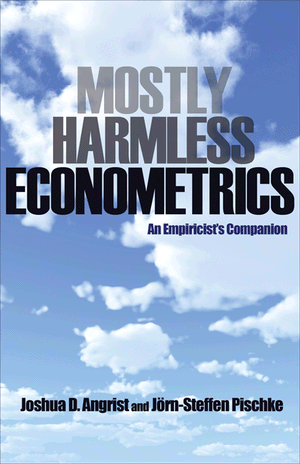
It can be debated whether Mostly Harmless Econometrics is indeed mostly harmless
That comes from Andrew Gelman’s review of Mostly Harmless Econometrics–the (comparatively) light and entertaining causal inference book by econometricians Angrist and Pischke.
Gelman likes the book, and has many interesting things to say, but this is not a bad summary of his main point:
I am a little worried that students and researchers in economics might be misled by Angrist and Pischke’s conversational yet authoritative tone into thinking that the model and predictors come to the researchers fully formed.
…To defend Angrist and Pischke here, I might say that statisticians such as myself are all too concerned about modeling the data, enough so that they (we) shortchange the ultimately more important goal of causal inference.
Slightly more pointed critiques of the treatment effects approach come from Angus Deaton, Heckman and Urzua, and Heckman and Vytlacil. All are worth reading.
In my statistics post last week, several readers suggested Mostly Harmless as a solid student introduction to econmetrics. I disagree. It is the perfect book for advanced undergrads and graduates–I basically forcefeed the book to my students if I have to–but it is no beginner introduction.
Also, like Gelman says, it’s focused on just one realm of stats. But I convinced all of the empiricists in my department to buy the book and, like me, they are thrilled with the result.
One Response